On this page:
I created this app concept and high-fidelity prototype for a fun nutrient-tracking app in 24 hours at the 2025 MSU Designathon, a UX/UI design competition & conference for student designers.

Won Best Prototype and Best Overall at the 2025 MSU Designathon
Project
App Concept &
High-Fidelity Prototype
Timeline
March 22nd & 23rd, 2025
My Role
Interaction & Content Designer
Team
3 people: Lead Researcher,
Editor/Analyst, and me
Skills
Low & High Fidelity
Prototyping, Brand Design,
Secondary Research,
Data Visualization
Tools
Figma, Google Suite, Devpost
The Prompt
“Gamify“ an experience: Incorporate game mechanics or features (e.g., rewards, points, rounds, avatars) into an everyday tool or experience.
See the rest of the requirements and judging criteria
-
Problem Definition
Define a problem, who it impacts, and why it matters. -
Problem Scoping
Use solid evidence, data, or case studies to demonstrate the problem’s real-world significance. -
Hypothesis
Propose a solution including a well-reasoned approach, justification, and clear success criteria. -
Design Execution
Develop a solution with strong design, usability, and iteration based on feedback. -
Testing & Refinement
Conduct research and testing to validate the solution. Demonstrate meaningful results and strong iteration based on insights.
Brainstorming
Our Ideas
We started by discussing everyday problems we might be able to solve with a game. Decision fatigue, the overwhelming exhaustion of having too many choices to make in a day, was a common theme in our brainstorm. We began listing decision-heavy aspects of life and ultimately chose to narrow our focus to eating, as a lot of existing tools for “healthy” eating promote shame. With a gamified lens, we could flip this pattern and use fun as a motivator!
Secondary Research
Our next step was gathering background information about the specific problems people face with eating healthily. Our findings helped us decide to center our app around nutrition and gaining the proper nutrients.
Nutrition: A Larger Issue
-
Nutrient Deficiencies
According to the FDA, most Americans do not, “… eat enough fruits, vegetables, dairy, seafood, whole grains and healthy oils, and consume too much saturated fat, sodium, and added sugars (FDA, 2025).” -
Health Disparities
People most affected by over/malnutrition are minority groups, those with lower socioeconomic status, rural populations, and other underserved communities (FDA, 2025). -
College Students
College students are at risk of developing poor eating habits due to factors such as economic conditions, academic stress and lack of information about nutritional concepts (Almraie, 2024). -
Implications
“Poor nutrition plays a key role in chronic but preventable diseases, which are leading causes of death and disability in the U.S. (FDA, 2025).”
User Persona
To envision who our app might help – and what features would be most important to include – we created a user persona. Meet Isabelle!
Isabelle Reyes
Context
She’s a busy, overwhelmed college student feeding herself for the first time in the dining halls. She frequently finds herself stuck, trying to decide what to eat next. She often feels tired.
Challenge
She tries to eat some vegetables and protein with every meal, but doesn’t know how to make sure she’s getting all the right nutrients.
Change
She finds NibbleMate, a free app that uses a game to help her identify, break down, meet, and track her nutrition goals.
Connection
She uses the app’s suggestions to help inform her decisions in the dining hall.
Carry-forward
The dining hall is no longer as overwhelming. She has fun taking care of her avatar while learning to pick foods that align with her goals and make sure she gets all the nutrients she can using the limited options in the dining hall. The app is just funny and weird enough that her friends want to try it now, too!
Proposed Solution
NibbleMate
A gamified nutrition app in which users log meals to “feed” their character and meet nutrient goals.
Unlike many health and fitness apps, NibbleMate motivates users to improve their health through fun incentives, rather than dread and guilt.
How does NibbleMate help?
- Guides goal-tracking, allowing users to choose aspects of their health to focus on
- Incentivizes intentional eating centered around nutrients, rather than weight loss
- Reduces decision fatigue when picking what to eat
- Graphs nutrients to show users the categories they’re lacking at a glance

How do the game aspects work?
- Daily and weekly challenges to motivate friendly competition and personal goal achievement
- Incentivization: completing goals earns gem (in-game currency)
Gems can be spent in the shop on:
- Different Home Types
- Living Rooms
- Gyms
- Kitchens
- Home decorations
- Pet outfits
- App accessories
- Background music, Interaction particle effects
- Character Customization
- Color-palette customization
Inspiration
We wanted to create a unique, fun nutrition tracking app, drawing inspiration from…
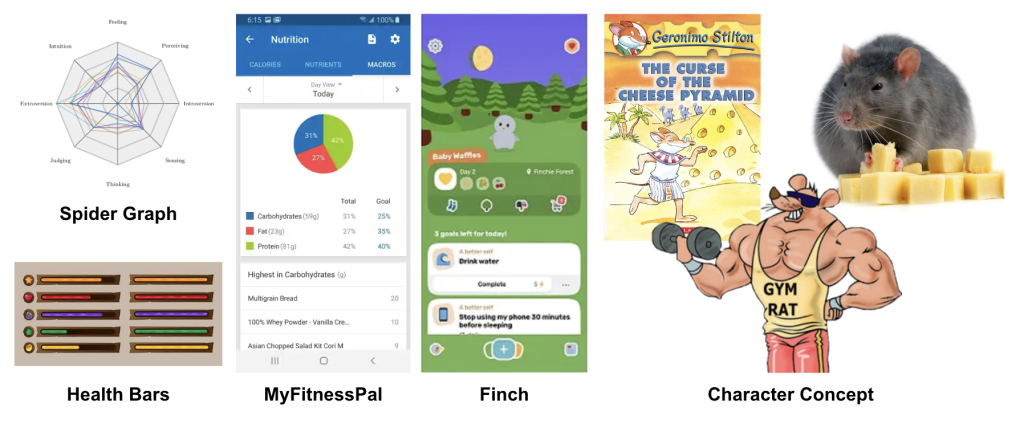
- Data visualizations like the spider graphs used in online personality test results
- Health progress bars in video games like Minecraft
- Simple food tracking systems like in the MyFitnessPal app
- Caring for an avatar like in the self care app Finch
- NibbleMate character concept from the phrase “gym rat”
In combining all of these aspects, we built a friendly, quirky platform that might interest people who are normally bored or intimidated by a typical, sterile health app like MyFitnessPal. NibbleMate is accessible, judgment-free, and just silly enough to attract its target audience: people who normally wouldn’t use a nutrition tracker.
Wireframe Sketches
The main challenge we faced with this project – aside from the 24-hour time crunch – was sorting through our ideas and prioritizing which features to include in our prototype. We decided to simplify the game and design aspects. Working within the time constraint, we worked together to narrow our focus to a more manageable scope, while still leaving room for the hope of adding onto the project in the future!

Low-Fidelity Prototype
Once we’d nailed down some layout ideas, we moved into Figma to create some initial low-fidelity mock-ups.
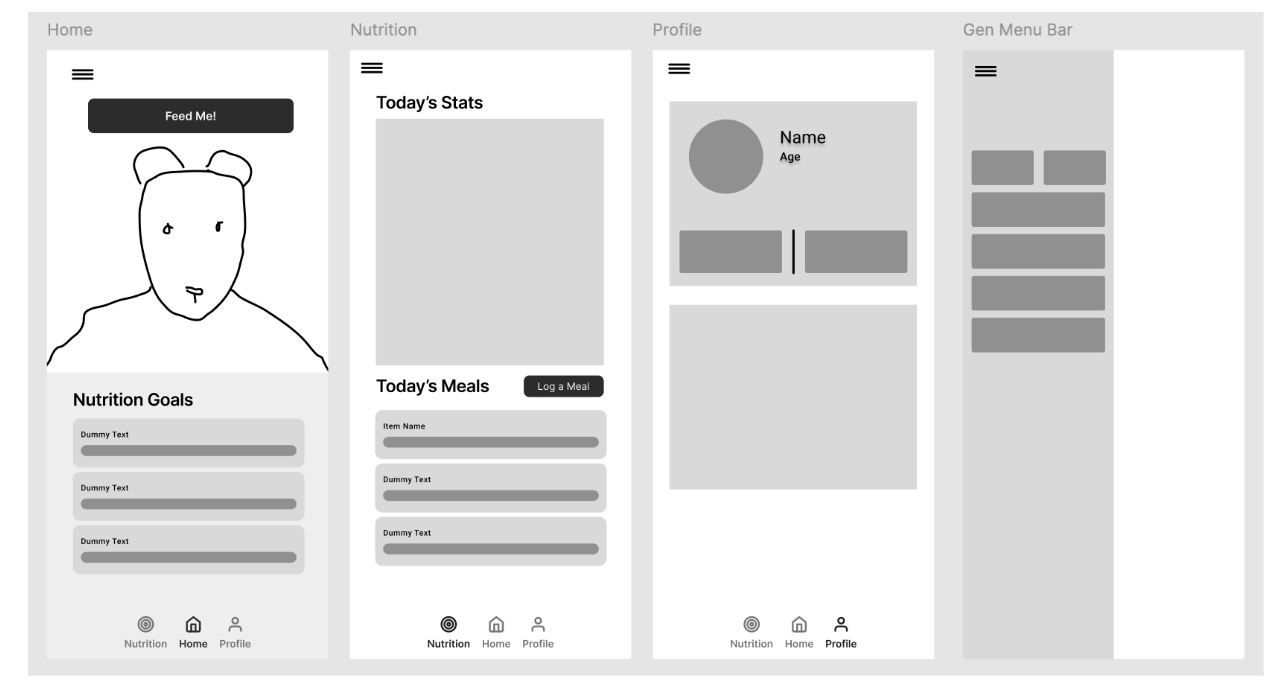
Next, we started to fill in some of the details. We decided to move the “Profile” tab from the bottom bar to the hamburger menu in the top right of each screen, since users will not need to access it frequently. Instead, we added a “Shop” icon to the bottom bar. This page will house prizes users can buy with in-game currency.

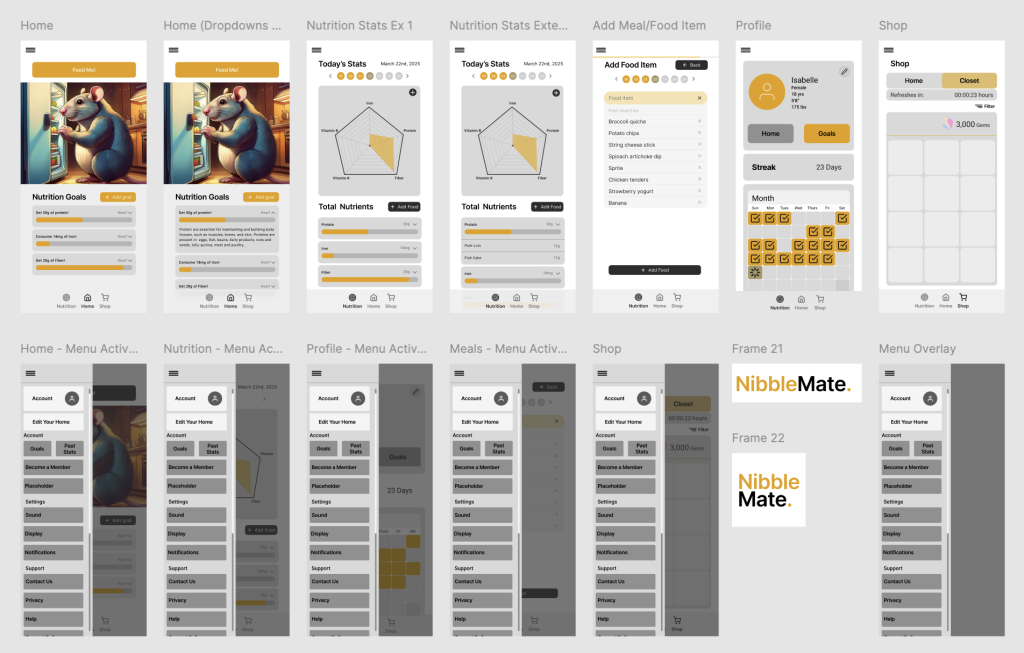
High-Fidelity Prototype
Finally, it was time to polish up our work into a high-fidelity prototype. We added in some color, choosing a gold and yellow color palette reminiscent of a rat nibbling on a block of cheese.
We also made our prototype interactive at this step. You can see it in action here!
What’s next for NibbleMate
With more time and resources, I see a real future for this app. I would focus on incorporating hand-drawn illustrations and animations to contribute to a playful, welcoming tone, building out the game aspects, adding social features to connect with friends on the app, and incorporating usability testing to identify additional pain points.
I’m also interested in adding customizable features for other use cases. Users could then use NibbleMate as they diet, manage a specific health condition, recover from an eating disorder, or otherwise reshape their relationship with food and nutrition.
It’s important that a nutrition app does not merely cater toward athletes or fitness enthusiasts – NibbleMate should be approachable to anyone as a path to intentional eating.
Takeaways
- This was my first big project on Figma and my interaction design and prototyping skills grew dramatically.
- I also learned how to work in a team for a short-term project with people I’d never met before, communicating and brainstorming together while respectfully debating to reach conclusions for important decisions. I learned to detach myself from my ideas and instead adopt a flexible and adaptable mindset.
- In addition to holding a design challenge, MSU’s Designathon also hosted industry professionals who led talks and workshops. While working on NibbleMate, I implemented a lot of what I learned throughout the weekend: UX writing and storytelling, creating cohesive visual identities, and communicating to make design choices within a group.
- Surprisingly, we won! Out of sixteen projects submitted, ours was voted Best Prototype and Best Overall Project by the team of student, faculty, and professional judges!